

 Medically Cited
 0 Reviews
  Specs
Specs Ask a Question
 Write a Review
Matcha products vary considerably in sourcing, flavor, processing, and price, even when they are all marketed as ceremonial grade.
RINSUI Master Collection is positioned as the richest and most full-bodied option in the brand’s matcha range. It contains 100% Japanese matcha sourced from Kagoshima and is intended for traditional preparations such as usucha and koicha, as well as matcha lattes.
This review looks at its ingredient profile, sourcing, preparation methods, naturally occurring tea compounds, testing claims, customer feedback, and overall value.
Quick Verdict
RINSUI Master Collection is a single-origin Japanese matcha that has a relatively simple ingredient list. No added sweeteners, flavors, colors, or other functional ingredients are listed.
The most notable traits of its origin are that it is from Kagoshima, has a more complete flavor profile, can be prepared in a variety of ways, and is supposed to be tested by third parties. The company does not provide standardized quantities of naturally occurring substances like caffeine or L-theanine, which can make it difficult for some people to find specific nutritional and/or functional amounts.
What Is RINSUI Master Collection?
The RINSUI Master Collection is a ceremonial-grade Japanese matcha tea from tea grown in Kagoshima, Japan.
The brand says it tastes rich and full-bodied, with layers of umami and natural sweetness, while its velvety texture and smooth finish are what it refers to. It comes in 40g and 100g sizes and can be used to make usucha, koicha, and a matcha latte with milk.
How Does It Rate?
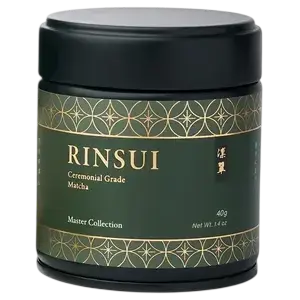 RINSUI Master Collection


Brand Highlights
- Focuses primarily on Japanese ceremonial-grade matcha.
- Sources blends from different tea-growing regions in Japan.
- Emphasizes Japanese tea craftsmanship and traditional preparation.
- Positions its range around origin, flavor, purity, and minimal ingredients.
Key Ingredients
- Japanese Matcha
- L-Theanine
- Caffeine
- Catechins and EGCG
Pros
- Contains only 100% Japanese matcha.
- Uses single-origin tea sourced from Kagoshima.
- Can be prepared as usucha, koicha, or a matcha latte.
Cons
- Its richer flavor may not suit people who prefer lighter matcha.
- Premium ceremonial-grade matcha generally costs more than culinary matcha.
- Exact caffeine content per serving is not listed.
- Standardized L-theanine or catechin amounts are not disclosed.
Product Specifications
| Specification | Detail |
|---|---|
| Product Type | Japanese ceremonial-grade matcha powder |
| Ingredient | 100% Pure Japanese Matcha |
| Origin | Kagoshima, Japan |
| Sizes | 40g and 100g |
| Standard Preparation | 2g for usucha or latte; 4g for koicha |
| Testing | Independent lab testing reported by the brand |
| Flavor Profile | Rich, full-bodied, velvety, layered umami |
| Price | From $32.00 on sale |
| Availability | Amazon |
About the Manufacturer
RINSUI (??) is a matcha line that focuses on Japanese tea craftsmanship and tea-making tradition. It has a variety of products, such as various Japanese matcha blends from tea-growing areas like Uji, Kagoshima, and Miyazaki.
As part of the production process, the company highlights the importance of sourcing, shade growing, harvesting, selection of good quality, steaming, and milling. It emphasizes its products on taste, origin, simplicity, and traditional tea-making methods, instead of a wide spectrum of functional ingredients or supplement-like formulations.
How Does It Work?
Matcha tea is a powdered tea leaf, as opposed to a brewed tea. This means that the beverage contains natural products found in the tea leaf such as caffeine, L-theanine, catechins, and other polyphenols.
Caffeine is linked to alertness, and L-theanine is widely studied alongside caffeine for its effects on attention and cognitive function. Matcha is also rich in Catechins like EGCG.
Concentrations do, however, vary by cultivar, growing conditions, harvesting, processing, and serving sizes. In general, research conducted on matcha or green tea should not be taken as proof that any product containing matcha or green tea will contain the same amounts and will have the same impacts.
Key Ingredients in RINSUI Master Collection
RINSUI Master Collection has only one listed ingredient: matcha. The other components below occur naturally within matcha and are not separately added ingredients.
Japanese Matcha
Matcha is a powdered form of Camellia sinensis in which the tea leaf itself is consumed. Human research has examined matcha as a source of naturally occurring catechins, theanine, and caffeine, although the amounts can differ between products and serving sizes.
L-Theanine
L-theanine is an amino acid naturally present in tea. A systematic review and meta-analysis examining tea compounds found that L-theanine, particularly when combined with caffeine, may influence certain aspects of attention and cognitive performance, though findings are not uniform across all studies.
Caffeine
Matcha naturally contains caffeine, although RINSUI does not disclose the precise amount per serving. Research on matcha and caffeine suggests that caffeine contributes to changes in alertness and reaction-time measures observed in some studies.
Catechins and EGCG
Catechins are naturally occurring polyphenols found in green tea, with EGCG being one of the most widely studied. A meta-analysis of randomized trials reported changes in some antioxidant-related measures following green tea supplementation, although not every biomarker showed consistent effects. Research on green tea catechins
Potential Benefits
These points reflect characteristics of matcha and its naturally occurring compounds rather than confirmed outcomes from RINSUI Master Collection itself.
- Simple Ingredient Profile: The product contains only Japanese matcha without additional sweeteners, flavors, or supplement ingredients.
- Naturally Occurring Tea Compounds: Matcha provides compounds such as caffeine, L-theanine, catechins, and other polyphenols.
- Preparation Flexibility: Master Collection can be used for usucha, koicha, or milk-based drinks.
- Distinctive Flavor Profile: The brand describes the matcha as rich, velvety, and high in umami, which may appeal to people who prefer stronger ceremonial matcha.
Safety and Side Effects
Matcha is usually used as a traditional tea drink, but there is natural caffeine in matcha. Some individuals may be more sensitive to caffeine and could experience jitteriness, gastrointestinal upset, or trouble falling asleep, especially if drinking high doses of it or matcha in the late hours.
RINSUI does not indicate the amount of caffeine in Master Collection, so consumers who prefer to be able to closely track their caffeine consumption might want to consider the possibility of some uncertainty.
Each batch is individually tested by a third party for heavy metals, pesticide residue, and microbial contaminants prior to packaging, as per the company’s claim.
What Customers Are Saying
Here’s what customers had to say:
The matcha has a smooth texture and a deeper flavor than some others I’ve tried. I mostly drink it with milk, where the stronger taste works well. The price is a little higher than everyday matcha, but the tin has lasted me a reasonable amount of time. – Maya R.
I found the color and texture to be good, and it whisked without too much clumping. The flavor is quite rich and slightly more intense than I expected, so I prefer using a bit less powder. Overall, it’s been consistent, but definitely more suited to people who already enjoy matcha. – Daniel K.
This was easy to prepare and had a noticeable umami taste with very little harsh bitterness. I liked it better as usucha than as a latte, though that’s mostly personal preference. It feels like a premium product, but whether it’s worth the cost probably depends on how often you drink matcha. – Kevin S.
How to Use
For a matcha latte, RINSUI recommends sifting 2g of matcha into a bowl and adding 30ml of hot water at approximately 80°C/176°F. The mixture is whisked for 20 to 30 seconds before adding around 100ml of milk.
For usucha, the brand recommends 2g of matcha with approximately 60ml of hot water.
For koicha, the suggested preparation uses 4g of matcha with 40ml of hot water, mixed slowly until smooth and glossy.
How Much Does It Cost?
RINSUI Master Collection is listed from $32.00 for 40g at the current sale price on the official website. A 100g size is also available.
This places it in the premium ceremonial-grade matcha category rather than the lower-cost culinary matcha segment. The value will largely depend on how much importance a buyer places on single-origin sourcing, flavor profile, and traditional preparation.
Is RINSUI Master Collection a Scam?
There are no obvious indicators from the available product and brand information that RINSUI Master Collection is a scam.
The company operates an active retail website, provides contact details, identifies the Japanese origin of its different blends, publishes preparation instructions, and describes its production and testing practices.
As with most premium matcha brands, claims relating to sourcing, testing, and quality ultimately depend on the accuracy and documentation behind the company’s representations.
FAQs
Q: Where does RINSUI Master Collection come from?
A: The matcha is sourced from Kagoshima, Japan.
Q: Does it contain ingredients other than matcha?
A: No, the listed ingredient is 100% pure Japanese matcha.
Q: Does RINSUI Master Collection contain caffeine?
A: Yes, Matcha naturally contains caffeine, although the exact amount per serving is not listed.
Q: Can it be used for matcha lattes?
A: Yes, RINSUI provides preparation instructions for lattes as well as usucha and koicha.
Q: Is RINSUI matcha lab tested?
A: The brand states that each batch undergoes independent testing for heavy metals, pesticide residues, and microbial contaminants.
Q: Is Master Collection suitable for beginners?
A: It can be used by beginners, though its richer and more full-bodied flavor may appeal more to experienced matcha drinkers.
Conclusion
RINSUI Master Collection is a straightforward single-origin matcha product made from 100% Japanese tea sourced from Kagoshima. Its main selling points are its simple ingredient profile, richer flavor, traditional preparation options, and the brand’s reported third-party testing practices.
The product appears most relevant to people who are already interested in ceremonial-grade matcha and prefer a deeper umami profile. At the same time, the lack of disclosed caffeine, L-theanine, and catechin amounts limits how precisely its nutritional or functional profile can be assessed.
Overall, it is best evaluated as a premium Japanese matcha rather than as a functional wellness product.
Matcha has skyrocketed in popularity lately, with matcha lattes, shots, and even green teas appearing everywhere from health stores to coffee shops.
Below you'll find some of the most effective matcha products on the market today, in our opinion.

Verdict on Claimed Benefits: Below is our summary of the available evidence for the claimed benefits of below mentioned matcha collagen and green tea powders based on the available research:



 Ask a Question

 This article changed my life!
 This article was informative.
 I have a medical question.
 This article contains incorrect information.
 This article doesn’t have the information I’m looking for.










Customer Reviews & Ratings
1 out of 5Review this Product
Leave a review and share your experience with others.
Write a Review
How to Upload your Proof of Purchase:
Please follow the instructions listed below to upload your electronic proof of purchase.
If you are still not able to upload your proof of purchase, please contact us for further assistance (take a moment to look over the sample bill below).