Medically Cited
Six-pack abs are built by strengthening the abdominal muscles while also reducing the layer of body fat that covers them. Core exercises such as planks, ab wheel rollouts, pikes, weighted crunches, sit-ups, and windshield wipers can help train the muscles that create a more defined midsection.

However, exercise alone is not enough to make abs visible. Nutrition, body fat percentage, full-body training, recovery, and consistency all play an important role in achieving noticeable abdominal definition.
This article covers six effective core exercises for building six-pack abs, how to perform them correctly, common mistakes to avoid, and simple diet tips that can support better results.
Introduction
6-pack abs are among the most sought-after fitness objectives, but one of the most misinterpreted. Thousands of crunches a day are supposed to bring out a definition in the abs. In actuality, core exercises help to develop and strengthen the abdominal muscles, and nutrition, general training, and body fat reduction help reveal the abdominal muscles.
Having a good core doesn’t just look good. It provides posture, balance, athletic movement, lifting strength, and stability for day-to-day use. In this article, you’ll learn 6 great core movements, the correct way to perform each one of them, and some easy workout and diet advice that will help you see the muscles you’ve built.
There is much more to Six-Pack Abs than exercise.
Why Six-Pack Abs Require More Than Exercise
There is much more to Six-Pack Abs than exercise.
Creating a 6-pack is actually a two-step process: Strengthening the abs and decreasing the fat that lies over them. Core training can build and tone muscles, but if there is a lot of body fat, it might not be seen.
This is why nutrition is important. Body composition is achieved by a balance of calorie-controlled diet, adequate protein, whole foods, water and regular exercise. One PubMed-indexed study on abdominal exercise revealed that after 6 weeks of abdominal exercise alone, there was no significant decrease in the subcutaneous fat of the abdomen, but there was an increase in abdominal muscle endurance.
It’s also essential to be consistent. Abs aren’t created in one workout or from one “perfect” exercise. They are built up over time from repeat training, progressive overload, improved diet and adequate recovery.
6 Best Exercises for Six-Pack Abs
The following exercises target the core from different angles. Some focus on endurance, some build strength, and others challenge rotation, control, and stability. Together, they create a complete ab-focused routine.
Static Plank
This plank exercise is static, which is great for stability, endurance and control. It targets the rectus abdominis, transverse abdominis, obliques, shoulders, glutes and lower back stabilisers. To do this, keep the body straight on the forearm and toes and keep the core tight. Don’t lower or bring up your hips too much. Planks are important because they help to strengthen and stabilize the core, helping to improve posture and overall movement.
Ab Wheel Rollout
The ab wheel rollout is an excellent exercise for core strength. It targets the rectus abdominis, obliques, transverse abdominis, lats, and shoulders. For the execution, get on your knees with the ab wheel in front of you, slowly roll forward, and then slowly roll back using your core. It is important to keep your back from arching and move in a controlled manner. This exercise is difficult; beginners might begin by doing shorter rollouts and then escalating the range of motion.
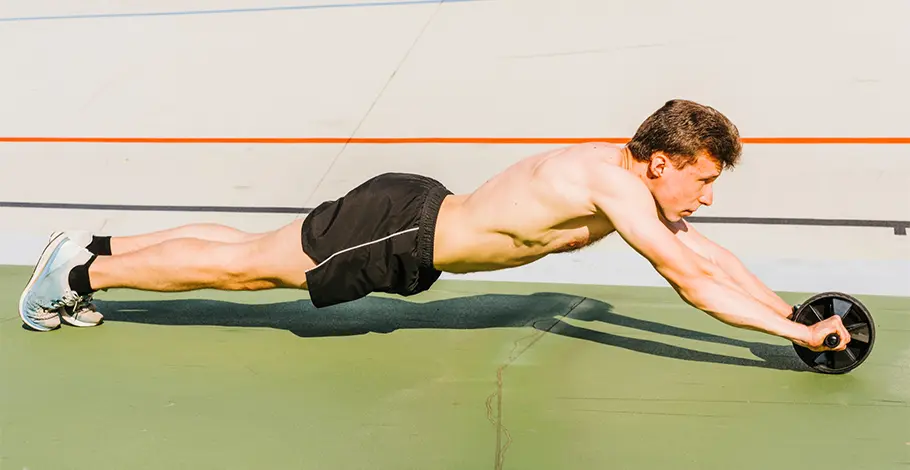
Ab Wheel Rollout
Pike
The pike is a fundamental exercise for the upper and lower abs and also enhances body control and balance. This can be performed with sliders, a stability ball, or suspension straps. On your hands and knees, straighten your legs and tuck your hips to the ceiling by bringing your feet towards your hands. Perform the motion slowly enough and do NOT rush it through. Pikes in particular are great for strengthening the rectus abdominis, hip flexors, shoulders, and the deep stabilizing muscles.
Weighted Crunch
The weighted crunch is a really good ab workout for adding resistance to the crunch. It targets primarily the rectus abdominis—the one muscle most strongly associated with the six-pack shape. On your back with knees bent, grab a weight on your chest and bring your upper torso up to tighten your abs. Don’t use momentum or pull on your neck. Doing crunches that are weighted in a proper progression and form can create thicker and stronger abdominal muscles.
Sit-Up
The sit-up is a classic abs workout for core strength that has a greater range of motion than a crunch and strengthens the hip flexors as well. To do it, lie on your back with your knees bent, tighten your core, and raise your upper half toward your knees, then slowly bring your torso back down. Movement should be controlled, and no jerks of the neck or swinging of the body. Sit-ups can be a part of a well-rounded abdominal workout to enhance core or trunk strength and endurance.
Windshield Wipers
Windshield wipers are a great core exercise that works the obliques, lower abs, hip flexors, and stabilizing muscles. They are performed lying on your back with your legs raised and moving slowly from side to side, whilst maintaining a tight core. The motion should be slow and deliberate. Newbies may start with their knees bent or with less than a full range of motion. This exercise is particularly beneficial for enhancing side-ab control and building up side-ab definition.
Why Core Strength Matters
Good core strength makes it easier for the body to function. It stabilizes the spine, maintains posture, aids in balance and transmits forces from the upper to the lower body. It’s important when you’re exercising, sporting, lifting, walking and sitting for extended periods of time.
Core training is also linked with performance benefits. Meta-analysis of a systematic review has revealed enhancements in a range of performance variables such as balance and jumping outcomes following core training.
Of course, core strength is more than just about abs. It helps to make the whole body system a connected system.
Sample Six-Pack Workout Routine
Train abs 2–4 times per week, depending on your fitness level and recovery. You do not need to train your abs every day. Like other muscles, the core also benefits from rest and progression.
| Exercise | Sets | Reps/Time | Rest |
|---|---|---|---|
| Static Plank | 3 | 30–60 seconds | 45 seconds |
| Ab Wheel Rollout | 3 | 6–12 reps | 60 seconds |
| Pike | 3 | 8–12 reps | 60 seconds |
| Weighted Crunch | 3–4 | 10–15 reps | 45–60 seconds |
| Sit-Up | 3 | 10–20 reps | 45 seconds |
| Windshield Wipers | 3 | 6–10 reps per side | 60 seconds |
For best results, combine this routine with full-body strength training, walking or cardio, enough sleep, and a nutrition plan that supports fat loss.
Common Mistakes That Slow Your Progress
Poor Form
Rushed reps and swinging, pulling on the neck, and arching the lower back make ab exercises less effective. The quality is more important than quantity. Thirty sloppy reps are typically worse than 10 controlled reps.
Ignoring Nutrition
There are a lot of people who work out heavily but aren’t eating properly to achieve their objectives. Even if you do the core exercises regularly, if you have a regular diet of more calories than you burn, your body fat may stay high.
No Progressive Overload
Reaping the same benefits time and again can slow progress. Progressively add difficulty by loading, adding control, adding reps, adding time under tension, and/or adding harder variations.
Unrealistic Expectations
It takes time to get six-pack abs. The rate of results is influenced by genetics, initial physique, training, stress, sleep, and nutrition. An honest attitude is simpler to sustain and more successful in the long run.
To get rid of stubborn belly fat, follow these diet tips for visible abs.
Diet Tips for Visible Abs
Eat Enough Protein
Protein promotes muscle repair and fullness and helps maintain lean body mass. A 2022 systematic review and meta-analysis found that increasing daily protein intake contributed to gains in lean body mass, especially when paired with resistance training.
Create a Moderate Calorie Deficit
Most people would need to decrease their body fat to see the abs. Typically, a moderate calorie deficit is more maintainable than extreme diets. The aim is not to restrict, but to make steady progress.
Choose Whole Foods Often
Eat lean proteins as the main part of most meals, with plenty of vegetables, fruits, whole-grain products, legumes, nuts, seeds and healthy fats. The foods are nutritious and keep hunger at bay.
Limit Liquid Calories and Highly Processed Snacks
High intake of sugary drinks, lots of desserts and food that’s high in calories can make it more difficult to lose weight. You don’t have to give up on them permanently; just try to reduce their frequency.
Stay Hydrated and Sleep Well
Hydration influences training performance, digestion, and sleep, and has an impact on recovery, hunger, and energy. Not sleeping well can make it more difficult to control cravings and train regularly.
Conclusion
Building six-pack abs is not about doing endless crunches. The best approach combines smart core training, full-body exercise, proper nutrition, and recovery. Static planks, ab wheel rollouts, pikes, weighted crunches, sit-ups, and windshield wipers can all help strengthen and develop the abdominal muscles when performed with good form.
For visible definition, focus on reducing body fat gradually, eating enough protein, training consistently, and giving your body time to recover. Six-pack abs are built through patience, structure, and repeatable habits.
Was this article helpful?
2 Sources
We review published medical research in respected scientific journals to arrive at our conclusions about a product or health topic. This ensures the highest standard of scientific accuracy.
[2] Core training and performance: a systematic review with meta-analysis: https://pubmed.ncbi.nlm.nih.gov/37867742/






 This article changed my life!
 This article was informative.
 I have a medical question.
 This article contains incorrect information.
 This article doesn’t have the information I’m looking for.