

 Medically Cited
 0 Reviews
 Specs
 Ask a Question
 Write a Review
Ever prepared your own matcha and got a bittersweet, chalky or dull result? You’re not alone. It is one of the most frequent complaints, and that’s why many begin to search for another effective powder.
One option that’s available is Encha’s Ceremonial Grade Matcha, a Japanese, first-harvest, organic powder that the brand says is naturally sweet, creamy and never bitter. That’s a big promise for a bag of green powder.
This review looks at what’s inside and what research says about the compounds in matcha, so you know what’s worth considering before you order.
Quick Verdict
Encha’s Ceremonial Grade is a USDA Organic matcha tea that is made from just one ingredient and comes with a lot of detail about where it’s from and a clear serving size. The brand sends mixed signals, though. One line says it’s crafted for milk, another says water only, and two different water temperatures appear. Opened packages can’t be returned, either. It’s a solid pick for matcha drinkers who want a straightforward product. It’s less ideal for first-timers who’d like a safety net.
What Is Encha Ceremonial Grade Matcha Powder?
It’s organic matcha green tea powder, and nothing else. Encha is said to be produced from spring’s youngest leaves, grown with shade, hand-picked within 24 hours after harvesting, and stone ground on Japanese millstones.
It is a master blend from six cultivars grown on farms in Kagoshima, Miyazaki, Shizuoka and Uji. It’s naturally sweet with a creamy umami quality and a light astringency. It comes in 30g, 60g, and 500g bags, plus a 30-pack of single-serve sticks.
How Does Encha Ceremonial Grade Matcha Rate?
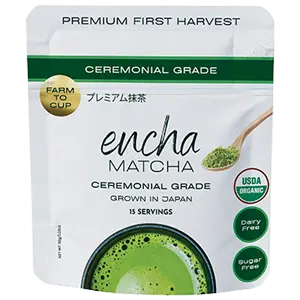 Encha Ceremonial Grade Matcha Powder


Brand Highlights
- Twelve years of direct partnership with farms in four regions of Japan.
- Offers free shipping on all orders.
- Gives subscribers 15% off with a monthly delivery option.

Key Ingredients
- Whole Shade-Grown Matcha Leaf
- L-Theanine
- Caffeine
- EGCG (Catechins)
Pros
- Single organic ingredient with nothing added.
- Clear serving size and cup count on every bag.
- First-harvest leaves, shade-grown and stone-ground.
Cons
- Opened packages can’t be returned.
- It gives conflicting advice on milk and water temperature.
- Caffeine, L-theanine, and EGCG amounts aren’t listed.
- Some reviewers report weak seals on the resealable bags.
- Sourcing is described in two different ways.
Product Specifications
| Specification | Detail |
|---|---|
| Product Type | Ceremonial-grade matcha powder |
| Origin and Harvest | Japan (Kagoshima, Miyazaki, Shizuoka, Uji); first harvest |
| Serving Size | 1 tsp (about 2 grams) |
| Certifications | USDA Organic; third-party tested for purity (brand-reported) |
| Return Policy | Opened packages can’t be returned; quality issues handled through support |
| Price | $19.99 |
About the Manufacturer
Encha sells matcha in three grades, ceremonial, latte, and barista, along with latte blends and a large library of recipes. The company says it’s built on twelve years of direct partnerships with Japanese farms and describes its products as USDA Certified Organic and third-party tested.
Those are company statements, and they doesn’t display test results for readers to check. The FAQ also describes the matcha as grown on “our farm in Uji,” while the product description lists four growing regions, so it’s worth asking the company which is accurate.
How Does It Work?
Matcha leaves are shaded prior to picking, which retains L-theanine, an amino acid connected to calmness with alertness. The whole leaf is then ground to powder, making it a drink of leaf instead of a ‘steaped’ infusion. Research into the combination of caffeine and L-theanine provides some evidence to support the notion.
A randomized, placebo-controlled study of 44 young adults found that 97 mg of l-theanine and 40 mg of caffeine helped to increase the accuracy of task switching and self-reported alertness.
The one 12-month matcha trial found used 2 grams daily, about the same as Encha’s listed serving.
Key Ingredients in Encha Ceremonial Grade Matcha
There’s only one ingredient here, organic matcha, so the sections below cover the compounds inside it and what research says about each.
Whole Shade-Grown Matcha Leaf
Matcha means consuming the entire ground leaf. A research in PMC notes that adds fiber but may also increase exposure to what the leaf absorbs, like lead, cadmium, and fluoride. One analysis measured fluoride near 120 mg per kilogram in matcha powder.
L-Theanine
Shading helps leaves keep this calming amino acid, but amounts vary widely. A lab analysis found roughly 8.5 mg to 41 mg per gram across matchas. In a randomized trial, theanine paired with caffeine improved task-switching accuracy over placebo.
Caffeine
First-harvest, higher-grade leaves tend to carry more caffeine and L-theanine together. In a trial of 27 adults, the caffeine and theanine combination improved the speed and accuracy of attention switching.
EGCG (Catechins)
EGCG is matcha’s best-known antioxidant. The same PMC analysis found high-theanine matcha had less of it, about 57 mg per gram versus 80 mg in low-theanine samples. Liver injury reports, including one published case tied to a weight-loss supplement, involve concentrated green tea extracts, not the drink.
Potential Benefits
These are the benefits Encha markets and what customers tend to report, not proven results for this exact product.
- Calm, Focused Energy: Encha points to L-theanine as the source of steady energy without the jittery crash that coffee can bring, and many reviewers describe a gentler lift.
- Smooth, Low-Bitterness Flavor: The brand rates its ceremonial grade at 5 out of 100 for bitterness, and several reviewers call it smooth and clean-tasting.
- Quick Daily Ritual: Preparation takes under two minutes, and customers often describe it as an easy, enjoyable way to start the morning.
- Morning and Early-Afternoon Fit: Encha suggests morning or early afternoon, with a reminder to avoid it close to bedtime if you’re sensitive to caffeine.
Safety and Side Effects
Matcha is generally safe for most healthy adults in normal amounts. Liver concerns tied to green tea mostly involve concentrated extract pills, not the drink. Still, matcha contains caffeine, and because the whole ground leaf is consumed, it also takes in whatever the leaf absorbed from the soil.
Encha advises that anyone who’s pregnant, nursing, or managing a medical condition talk to a doctor first, and it doesn’t recommend matcha for young children. People sensitive to caffeine should skip it close to bedtime. These statements haven’t been evaluated by the FDA.
What Customers Are Saying?
Encha has an average of 4.9 stars across 580 reviews with 92% of the reviews being five stars. There are some smaller numbers of serious reviews that refer to packaging, customer service and the learning curve when whisking, so read both sides!
I drink it in the morning usually in the form of an iced or warm with some honey. It’s a great way to start my day,” Julie wrote in her review.
Nia was more critical:
It’s a decent mid-tier brand, and the ceremonial grade is very good for the price. But the resealable bags keep losing their seal, and customer service wasn’t helpful when I reached out.
Mark had a different frustration:
Without a bamboo whisk, mine came out gritty. I ended up buying a frother, so factor that in.
How to Use?
Add 1 teaspoon of matcha to 5 ounces of hot water, whisk in a W motion for 15 seconds until frothy, then pour and add water to taste. A bamboo whisk gives the smoothest result, and a handheld frother or a sealed jar works as a substitute. A couple of details on the website don’t line up.
The instructions say 160°F, but the FAQ recommends 175 to 185°F. The header also describes the powder as crafted for milk, while the directions say it’s for water only and not for lattes. Encha sells a separate Latte Grade for milk drinks.
How Much Does It Cost?
The 30g bag costs $19.99 as a one-time purchase, or $16.99 with a monthly subscription that saves 15%. At 15 cups per bag, that works out to about $1.33 a cup, or $1.13 with a subscription.
Shipping is free on all orders. Prices for the 60g and 500g bags aren’t shown. Since opened packages can’t be returned, a first purchase carries some risk, so the smallest bag is the sensible way to test it.
Is Encha Ceremonial Grade Matcha a Scam?
No. It’s a real product from an established matcha company with an organic certification and a large base of positive reviews. The fair criticisms are about clarity rather than legitimacy. The product contradicts itself on milk, water temperature, and where the matcha is grown.
Test results aren’t posted for readers to check. And because opened food products can’t be returned, buyers who aren’t happy are limited to working things out with customer support. “Ceremonial grade” also isn’t a regulated term in the U.S., so it works as a brand label more than a guarantee.
FAQs
Q: How many servings are in one bag?
A: One serving is about 1 teaspoon, or 2 grams. A 30g bag makes 15 servings, a 60g bag makes 30, and a 500g bag makes 250.
Q: What water temperature should I use?
A: The instructions say 160°F, and the FAQ says 175 to 185°F. Hot but not boiling is the general rule, since water that’s too hot can bring out bitterness.
Q: Can I return an opened package?
A: No. Opened food and beverage products can’t be returned, but Encha says its support team will help find a solution if there’s a quality issue.
Q: Can I use it without a bamboo whisk?
A: Yes. A handheld milk frother, a fork, or shaking the matcha and liquid in a sealed jar all work, though a spoon alone can leave the drink gritty.
Q: Is matcha safe during pregnancy?
A: Matcha contains caffeine, so Encha recommends talking with a doctor first if you’re pregnant, nursing, or managing a medical condition.
Q: What’s the difference between Encha’s three grades?
A: Ceremonial grade comes from premium first-harvest leaves and is meant to be whisked with water. Latte grade uses standard first-harvest leaves with a stronger taste that balances milk. Barista grade comes from second-harvest leaves and is built for lattes, smoothies, and baking.
Conclusion
Encha’s Ceremonial Grade Matcha is an easy-to-use, organic, well-reviewed, and relatively inexpensive matcha powder that has an easy serving size. Where it falls short is consistency and flexibility. The product contradicts itself on milk, temperature, and sourcing, test results aren’t shown, and the no-returns-once-opened rule leaves little room if the flavor isn’t to your liking.
None of that means it isn’t a good product. It simply implies that one has to keep their expectations realistic. It is a good option if you are a fan of traditional matcha green tea and don’t mind with the smallest bag. Other options may be more suitable if you are looking for a guarantee or a well-defined set of instructions.
Matcha has skyrocketed in popularity lately, with matcha lattes, shots, and even green teas appearing everywhere from health stores to coffee shops.
Below you'll find some of the most effective matcha products on the market today, in our opinion.

Verdict on Claimed Benefits: Below is our summary of the available evidence for the claimed benefits of below mentioned matcha collagen and green tea powders based on the available research:



 Ask a Question

 This article changed my life!
 This article was informative.
 I have a medical question.

 This article contains incorrect information.
 This article doesn’t have the information I’m looking for.







Customer Reviews & Ratings
1 out of 5Review this Product
Leave a review and share your experience with others.
Write a Review
How to Upload your Proof of Purchase:
Please follow the instructions listed below to upload your electronic proof of purchase.
If you are still not able to upload your proof of purchase, please contact us for further assistance (take a moment to look over the sample bill below).