Medically Cited
Stretch marks are a type of scar and appear where skin expands or contracts beyond its ability to keep up. They frequently occur on the legs at the thighs and calves, associated with growth spurts, weight loss or gain, pregnancy or even merely muscle development due to workouts.
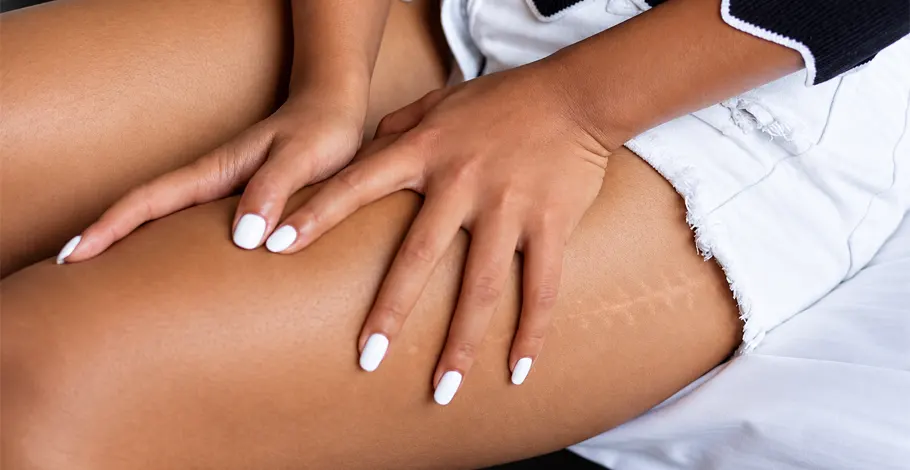
The lines themselves aren’t harmful. They don’t itch all day and all night; they don’t spread to other people, and they certainly don’t signal that something is wrong with you. What they can do is bother a person cosmetically, and that is why so many individuals go searching for a remedy.
Here’s the real deal on what works, what’s mostly marketing, and what a realistic timeline looks like.
Key Takeaways
- Stretch marks on the legs are common and harmless; they’re a form of scarring, not a medical problem.
- No cream, procedure, or home remedy can guarantee complete removal, but several treatments can fade color and smooth texture.
- Newer, reddish or purple stretch marks generally respond better to treatment than old, silvery-white ones.
- Diet, hydration, and exercise support skin health in general, but they won’t erase marks that already exist.
What Do Stretch Marks on Legs Look Like?
Stretch marks are not the same for everyone and even for any one person, they are not the same over time. Fresh ones are more likely to be red, pink or purple, sometimes with a slightly raised or itchy appearance while the skin is healing.
They usually grow into a narrow, flat stripe that becomes white or silvery, particularly against lighter skin, in a year or two. They appear most frequently on the legs, on:
- Thighs (inner and outer).
- Backs of the knees
- Calves (in rare cases, it happens)
- Bases of the thighs, at the hip.
They typically occur in parallel bands, sort of like tiger stripes, in the direction the skin was stretched.
What Causes Stretch Marks on Legs?
Stretch marks are caused by the middle layer of skin, the dermis, being stretched or bulging more than it can keep up with the collagen and elastin fibers. The fibers rip apart at a molecular level, and the impression is the apparent scar left by the ripping. It seems to be provoked by a few things on the legs specifically:
- Rapid growth and puberty: Teens who are in a growth spurt may have marks on the thighs in the blink of an eye.
- Weight gain or loss rapidly: When the weight changes quickly, the skin stretches or droops more than it can be remodelled.
- Pregnancy: Fluid retention and hormonal changes may impact the thighs and hips, not just the tummy.
- Muscle building: Heavy leg workouts, such as squats, sprinting, cycling, etc., can bulk up thigh muscle at a rate that can leave marks.
- Genetics: If your parents tend to have stretch marks, there’s a good chance you will as well.
- Use of corticosteroid products: Chronic treatment with corticosteroid creams or medications can cause thinning of the skin and loss of its elasticity which increases the likelihood of marks.
Can You Completely Get Rid of Stretch Marks on Legs?
Here’s the ugly truth: no stretch mark cream, laser or otherwise is available that promises to make stretch marks disappear forever. What treatment can do is even out the tone, make the lines blend in and fade out the color.
Timing matters a lot here. Newer marks that are still in that red or purple phase are more likely to be responsive, as the skin is still in the remodeling phase. Silvery marks that are older have more flattened scar tissue at that point and they are harder to maneuver.
How to Reduce the Appearance of Stretch Marks on Legs
Ask yourself what is bothering you the most: the color, texture, or both before you select a treatment. If you’re considering a sequence of procedures, ask about the chances of improvement, the fees, the time to recovery, and any side effects.
Moisturizers and Topical Products
Lotions and oils are sold aggressively as stretch mark treatments and one should be wary of them. While that’s not a bad thing, the proof that any cream by itself can remove or fade existing marks is minimal. If you’re willing to give it a shot, check to see if it contains hyaluronic acid or centella asiatica, and apply it regularly, not once and done.
Tretinoin for Newer Stretch Marks
Tretinoin, a prescription form of vitamin A, has some of the better research behind it, specifically for fresh, reddish marks rather than old ones. It works by encouraging collagen production in the skin. That said, it’s prescription-only; it can cause noticeable irritation and peeling while your skin adjusts, and it’s a hard no during pregnancy or while breastfeeding. Talk to a dermatologist before starting it.
Microneedling
Microneedling uses fine needles to create tiny, controlled punctures in the skin, which triggers the body’s own collagen and elastin production as it heals. It’s typically done in a series of sessions rather than once, and results build gradually rather than appearing overnight.
Laser Treatments
Different lasers target different problems; some focus on evening out discoloration, others on smoothing texture by stimulating collagen. Pulsed dye lasers, for example, tend to work best on newer, still-colored stretch marks. None of them are a single-visit fix; most people need several sessions, and a dermatologist should assess your skin tone and mark type first, since laser treatments carry some risk of pigment changes, especially on darker skin.
Other Dermatological Procedures
Microdermabrasion and similar resurfacing treatments can help smooth texture on older marks by removing the outer layer of skin, encouraging fresher skin underneath. It’s a supporting option rather than a cure, and it’s usually paired with other treatments for a more noticeable result.
Can Exercise, Diet, and Water Remove Stretch Marks?
Short answer: no, not the marks that are already there. Staying hydrated, eating a nutrient-rich diet, and exercising regularly all support healthier, more resilient skin overall, and they may help prevent new marks during periods of weight change.

Can Exercise, Diet, and Water Remove Stretch Marks
But there’s no research showing that drinking more water or taking a particular vitamin dissolves stretch marks that have already formed. Treat these habits as good general skin maintenance, not a treatment plan.
How to Prevent New Stretch Marks
Maintaining a steady, healthy weight, rather than cycling through fast gains and losses, is one of the more realistic ways to lower your odds of new stretch marks on the legs. That’s especially relevant if you’re building muscle quickly or going through a period of weight change; slowing the pace down, where possible, gives skin more time to adapt. That said, prevention isn’t guaranteed. Genetics play a real role, and plenty of people do everything “right” and still end up with marks anyway.
When Should You See a Dermatologist?
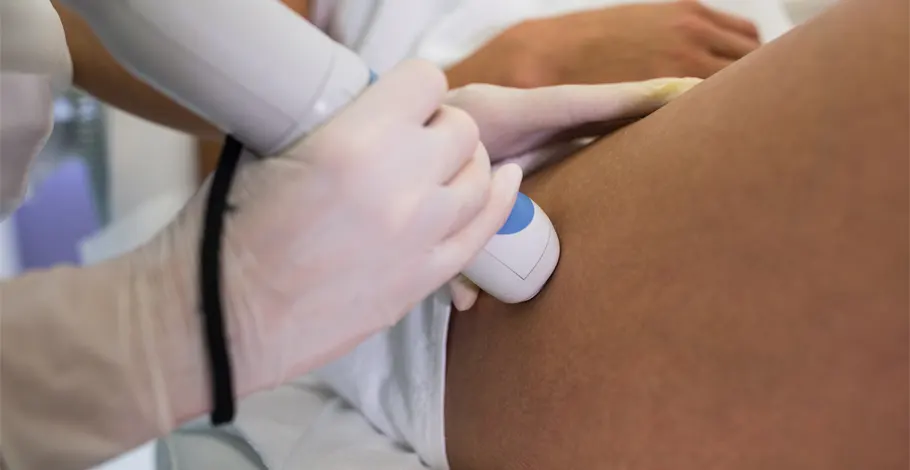
It’s worth booking an appointment if your stretch marks appear suddenly, spread rapidly, or cover a large area of your legs without an obvious cause like a growth spurt or pregnancy; that pattern can sometimes point to an underlying hormonal issue worth checking out.
When Should You See a Dermatologist
It’s also a good idea to see a dermatologist if you want access to prescription-strength or in-office treatments, since options like tretinoin or laser therapy work better under professional guidance than trial and error at home.
FAQs
Do stretch marks on legs ever fully disappear?
Rarely completely, but many fade significantly over months to years, especially with early treatment.
Are stretch marks on the legs a sign of a health problem?
Usually not. They’re typically tied to growth, weight change, or muscle gain, though sudden widespread marks are worth mentioning to a doctor.
Can men get stretch marks on their legs too?
Yes, particularly from rapid muscle growth through weightlifting or sports training.
Is it safe to use tretinoin while pregnant?
No. Tretinoin isn’t recommended during pregnancy or breastfeeding; check with a doctor for safer alternatives.
How long does it take to see results from treatment?
It varies by method, but most treatments, creams, microneedling, lasers, take several weeks to months of consistent use or multiple sessions before changes are noticeable.
Final Thoughts
Stretch marks on the legs are common, harmless, and nothing to stress over medically. They often fade on their own, and treatments like tretinoin, microneedling, or laser therapy can help move that process along and make marks less noticeable; just don’t expect a total disappearing act. Give it time, and be realistic about what “better” looks like.
Was this article helpful?
2 Sources
We review published medical research in respected scientific journals to arrive at our conclusions about a product or health topic. This ensures the highest standard of scientific accuracy.
[2] Topical tretinoin (retinoic acid) improves early stretch marks - PubMed : https://pubmed.ncbi.nlm.nih.gov/8624148/







 This article changed my life!
 This article was informative.
 I have a medical question.

 This article contains incorrect information.
 This article doesn’t have the information I’m looking for.