Medically Cited
Dark spots and wrinkles. Most people treat them as two totally separate problems. A brightening serum for one, a retinol cream for the other. But here’s the thing: these two skin concerns actually have way more in common than most people realize. Both are visible signs of aging. Both tend to show up around the same time. And this is what makes the connection so important: they’re often triggered by the exact same root cause.

Understanding that connection is really what makes prevention and treatment work. Once you know what’s driving both, you stop just managing symptoms. You start fixing the actual problem.
What Are Dark Spots?
Dark spots, also called hyperpigmentation, are areas where melanin, the pigment that gives skin its color, builds up more than in the surrounding tissue. The result? Patches that look darker than the rest of the skin. They’re extremely common, and they can show up on the face, hands, shoulders, and neck.
They come in a few different forms. Age spots and sun spots are among the most common, and years of UV exposure are usually behind them. Melasma is what typically shows up as larger patches, often triggered by hormonal changes, and it’s more common in women during pregnancy or while taking hormonal contraceptives. Post-inflammatory hyperpigmentation is what lingers after a breakout or skin injury, basically the dark mark that’s left behind once the original problem has cleared up.
What Causes Dark Spots?
Prolonged UV exposure is probably the single biggest cause of dark spots on the face and hands. When sunlight hits the skin over and over, it pushes melanocytes, the cells responsible for melanin production, into overdrive. Melanin builds up unevenly. Over time, those uneven patches become visible.
But UV exposure isn’t the only factor here. Hormonal shifts can alter melanin production quite a bit; pregnancy, certain birth control methods, and menopause are all known triggers. Skin trauma from acne, cuts, or inflammation can leave behind post-inflammatory hyperpigmentation, and honestly, this sometimes takes months to fade on its own. Genetics play a real role too, some people are just more prone to pigmentation changes than others.
And certain medications, estrogens, tetracyclines, phenytoin, among others, are known to sensitize skin to the sun, and they can cause spots with or without direct sun exposure. Worth flagging with a doctor if you’ve started a new medication and noticed changes in your skin.
How Are Dark Spots and Wrinkles Connected?
This is really the core of the whole conversation. Dark spots and wrinkles don’t cause each other. But they do develop together, and that’s because UV radiation is what drives both processes at once.
A PMC review on photoaging lays it out pretty clearly: UV radiation triggers a cascade of inflammatory responses that switch on enzymes known as matrix metalloproteinases (MMPs). These MMPs break down collagen and elastin, the structural proteins that keep skin firm and elastic, and that’s what leads to wrinkle formation. At the same time, UV exposure also ramps up melanin production in the skin, producing the uneven pigmentation we recognize as dark spots.
So the same hours of sun exposure slowly breaking down your collagen are also overstimulating your melanocytes. That’s why both tend to show up on the same parts of the face, around the eyes, cheeks, and forehead, and why they tend to intensify together with age. Photoaging, as dermatologists call it, is basically the visible result of both processes running in parallel.
Can Dry Skin Make Wrinkles and Dark Spots Look Worse?
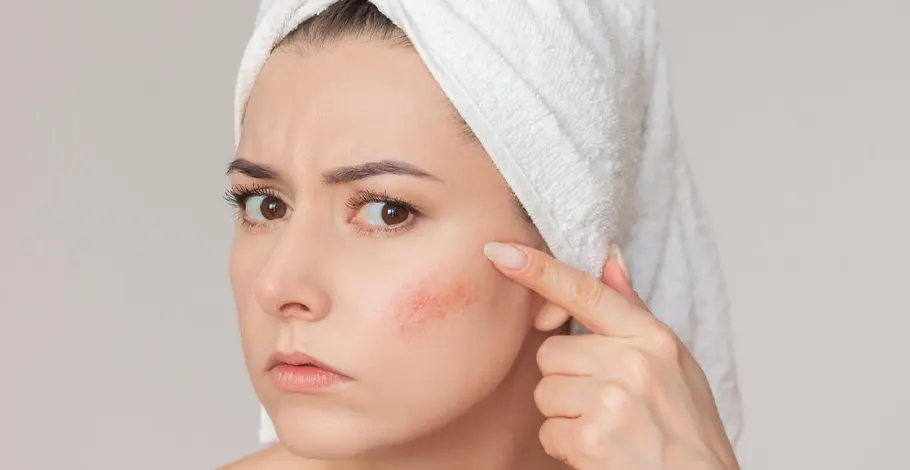
Dry skin doesn’t actually cause wrinkles. And it doesn’t directly cause dark spots either. But it can absolutely make both look more pronounced, and that’s a distinction worth understanding.
Can dry skin make wrinkles and dark spots look worse
When skin lacks moisture, fine lines lose the plumpness that makes them less noticeable. A well-hydrated face reflects light more evenly; dry skin scatters it, and shadows collect in the grooves of fine lines, making them look deeper than they actually are. At the same time, dull, dehydrated skin doesn’t reflect light the way healthy skin does, and that dullness is what makes pigmentation stand out even more against the surrounding skin.
Staying hydrated inside and out really matters here. Drinking enough water supports skin function, and a daily moisturizer, ideally applied morning and night, helps keep the skin barrier intact and cuts down on the appearance of both fine lines and uneven tone. It’s not a fix for the underlying issues. But it’s genuinely one of the simplest things you can do to make skin look better overall.
Treatments for Dark Spots and Wrinkles
The good news? Several skincare ingredients tackle both concerns at once, and that’s exactly what makes them worth building into a routine.
Vitamin C is probably the most well-studied option for hyperpigmentation. It blocks an enzyme called tyrosinase, which is involved in melanin production, and its antioxidant action also protects collagen from oxidative damage. Niacinamide is another strong performer, clinical trials published in Dermatology Research and Practice found that 4% niacinamide significantly reduced total hyperpigmentation area and improved overall skin lightness, with a tolerability profile comparable to hydroquinone.
Retinoids, retinol and prescription-strength tretinoin, speed up cell turnover, gradually fading pigmentation while also kicking collagen production back into gear. And exfoliating acids like glycolic and lactic acid help clear away built-up dead skin cells, making the complexion brighter and helping other active ingredients actually sink in.
For spots that haven’t budged after six to eight weeks of topical skincare, in-office options are the next step. Chemical peels can handle surface-level pigmentation fairly well. Laser treatments, particularly fractional and Q-switched lasers, are the most reliable option for deep or stubborn hyperpigmentation and visible wrinkle correction. One or two sessions can produce real results in the right candidates.
How to Prevent Dark Spots and Premature Wrinkles
Prevention is really what makes the biggest long-term difference, more than any treatment ever could. A PMC review on sunscreens and photoaging found that daily use of a broad-spectrum sunscreen with SPF 30 or higher is one of the most effective tools out there for cutting down UV-related skin aging, including both pigmentation changes and wrinkle formation. Applying it every single morning, not just on beach days, is what actually makes it work.
Beyond SPF, a few other habits are worth building in:
- Wear protective clothing and a hat when you’ll be outdoors for extended periods
- Pair your sunscreen with a vitamin C serum in the morning for extra antioxidant defense
- Don’t smoke — it accelerates skin aging measurably and contributes to both wrinkle formation and uneven skin tone
- Moisturize twice daily to support barrier function and reduce the appearance of fine lines
- Stay hydrated; water intake supports skin health from the inside out
None of this takes long. But done consistently, it’s genuinely protective over the years — in a way no treatment can replicate after the fact.
When Should You See a Dermatologist?
Most dark spots are harmless. But it’s worth getting professional eyes on any spot that changes in size, shape, or color, or that has irregular borders. These can occasionally signal something that needs medical attention rather than a skincare routine.

When should you see a dermatologist
You should also see a dermatologist if spots show up suddenly without an obvious cause, if they don’t respond to over-the-counter skincare after a few months, or if you’re considering laser treatment or prescription-strength ingredients like hydroquinone or tretinoin. A dermatologist can also tell you whether a spot is recent or deep-set, and honestly, that’s what determines whether a gentler at-home approach will work or whether something more intensive is needed from the start.
Rapidly worsening wrinkles or skin changes that seem out of proportion to age are also worth having checked out, especially if they show up alongside other symptoms.
Conclusion
Dark spots and wrinkles are separate skin concerns. But they’re connected in a way that actually makes things simpler, protecting your skin from UV damage is what helps prevent both.
The same daily sunscreen habit, the same antioxidant serum, the same commitment to consistent moisturizing, all of it adds up to healthier-looking skin over the long haul. Start early if you can. And if you’re already noticing changes, a solid skincare routine combined with professional guidance where needed can still make a real difference.
Frequently Asked Questions
Do dark spots cause wrinkles?
No, dark spots don’t cause wrinkles, and wrinkles don’t cause dark spots. But they frequently show up together because they’re both driven largely by UV exposure and the natural aging process.
Can I treat dark spots and wrinkles at the same time?
Yes, and several ingredients do both. Vitamin C, niacinamide, retinoids, and exfoliating acids all address pigmentation and collagen loss to varying degrees, which is what makes them efficient choices for a combined approach.
How long does it take for dark spot treatments to work?
Topical treatments typically take four to twelve weeks to show visible results. Deeper or older spots may need longer, or may need a professional treatment like a chemical peel or laser to actually respond.
Is dry skin more likely to develop wrinkles?
Not necessarily, but dry skin can make existing lines look more pronounced. Oily skin tends to hold onto moisture more easily, which can keep skin looking smoother for longer. Genetics and sun exposure are still the bigger factors overall, though.
When should I see a doctor about dark spots?
If a spot changes in appearance, has irregular edges, shows up suddenly without explanation, or doesn’t respond to several months of consistent skincare, see a dermatologist. It’s almost always nothing serious. But it’s worth confirming.
Was this article helpful?
3 Sources
We review published medical research in respected scientific journals to arrive at our conclusions about a product or health topic. This ensures the highest standard of scientific accuracy.
[2] A Double-Blind, Randomized Clinical Trial of Niacinamide 4% versus Hydroquinone 4% in the Treatment of Melasma - PMC: https://pmc.ncbi.nlm.nih.gov/articles/PMC3142702/
[3]Sunscreens and Photoaging: A Review of Current Literature - PMC : https://pmc.ncbi.nlm.nih.gov/articles/PMC8361399/



 This article changed my life!
 This article was informative.
 I have a medical question.

 This article contains incorrect information.
 This article doesn’t have the information I’m looking for.