Medically Cited
What Is Ankylosing Spondylitis?
AS, short for ankylosing spondylitis, is a type of arthritis. Long-term one. Goes after the spine and the sacroiliac joints too, where your lower spine meets the pelvis. NIAMS describes it as redness, heat, swelling, and pain right at that junction.

Ankylosing spondylitis (AS) doesn’t usually go away on its own. Inflammation can persist and gradually lead to pain, stiffness, and reduced flexibility. It often begins in early adulthood and tends to feel worse after periods of rest or first thing in the morning, which can be surprising because that’s not how many people typically picture arthritis.
Unlike many forms of arthritis that commonly affect the hands and knees, AS primarily affects the spine and the joints around it. Over time, repeated inflammation can cause the body to form new bone, which may eventually fuse parts of the spine.
This can reduce flexibility, affect posture, and make movement more difficult. In some people, AS can also affect other areas, including the hips, shoulders, ribs, and eyes.
What Causes Ankylosing Spondylitis?
Honestly? Nobody knows for sure. A mix of genetics, immune system stuff, something environmental too, probably all three together.
HLA-B27 is the gene everyone talks about. Strongest known risk factor. A lot of AS patients have it. But plenty of people carry it and never get AS at all; NIAMS notes this directly, which tells you something else has to be going on.
And for what it’s worth, this one gene only explains around 30% of the heritability, so there’s more genetics involved that scientists haven’t fully mapped yet.
The immune system’s in on it too. In AS, it starts attacking tissue it shouldn’t- healthy tissue around the spine and sacroiliac joints. A misfire. That’s what keeps the inflammation going, which over time causes the pain, the stiffness, sometimes real damage.
Researchers are also looking at environmental triggers, infections, gut microbiome changes, whether those set things off in people already genetically primed for it. Early research, though. Nothing settled. Bottom line, AS is complicated, autoimmune-linked, no one tidy cause.
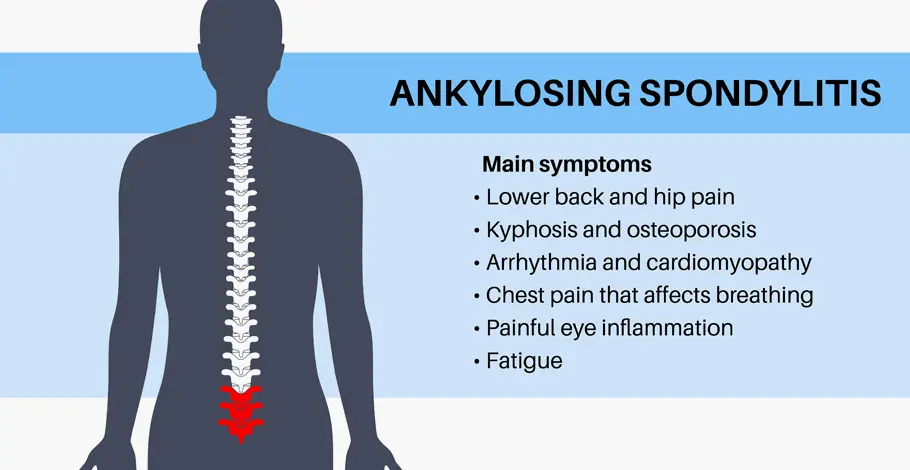
Ankylosing Spondylitis Symptoms
Risk Factors for Ankylosing Spondylitis
Several factors can increase the likelihood of developing ankylosing spondylitis (AS). Having one or more of these risk factors does not mean a person will definitely develop the condition, but it may increase the chances.
- Age: AS most commonly begins between the ages of 15 and 40, with symptoms often starting in the late teens or twenties.
- Gender: The condition is more commonly diagnosed in men than women, although women can also develop AS and may experience different or less typical symptoms.
- Family History: Having a close family member, such as a parent or sibling, with ankylosing spondylitis or another type of spondyloarthritis increases the risk.
- HLA-B27 Gene: People who carry the HLA-B27 gene are more likely to develop AS. However, many individuals with this gene never develop the disease, so it is only one part of the overall risk.
- Related Inflammatory Conditions: Certain inflammatory diseases are linked to a higher risk of AS, including:
- Inflammatory bowel disease (IBD), such as Crohn’s disease and ulcerative colitis
- Psoriasis
- Reactive arthritis
- Uveitis (inflammation of the eye), which can occur before or after AS develops
- Immune System Activity: An overactive or abnormal immune response is believed to contribute to the inflammation that causes AS, especially in people with a genetic predisposition.
While these factors can increase the risk, the exact cause of ankylosing spondylitis is still not fully understood. If you experience ongoing back pain and stiffness, especially at a young age, early medical evaluation can help with timely diagnosis and treatment.
How Is Ankylosing Spondylitis Diagnosed?

Diagnosed Ankylosing Spondylitis
Not simple. Early symptoms overlap with a bunch of other conditions, so there’s no single test. Doctors piece it together.
Starts with history. When did symptoms begin? Does moving help or does resting make it worse (a telltale sign, actually; mechanical back pain usually works the opposite way).
Morning stiffness comes up a lot. So does family history, and past eye inflammation, psoriasis, IBD. Then a physical exam, checking the spine and sacroiliac joints, posture, flexibility, range of motion, chest expansion while breathing.
Imaging’s next. X-rays can catch changes in the spine and joints, but early on those changes often aren’t visible yet. That’s where MRI helps; it can pick up inflammation before any damage shows on an X-ray.
Blood work rounds things out, though it can’t diagnose AS alone. The HLA-B27 test checks for that gene, common in AS but not universal. CRP and ESR, inflammatory markers, can hint something’s active, but normal results don’t rule AS out either.
Given how much back pain overlaps across conditions, doctors typically rule out other arthritis types, mechanical back issues, and other inflammatory disorders before confirming AS.
Treatment For Ankylosing Spondylitis
No cure, not yet. But treatment genuinely helps, controls inflammation, eases pain, keeps mobility up, and slows progression. Best results usually come from combining several things at once.
NSAIDs are typically where doctors start, for pain, stiffness, inflammation. If that’s not enough, biologics come next: TNF inhibitors, IL-17 inhibitors, targeting the immune system more precisely.
DMARDs sometimes get added if AS hits joints outside the spine. Corticosteroid injections show up occasionally, for calming inflammation in one specific joint.
Physical therapy matters more than people expect. A good therapist builds something tailored: flexibility, posture, strengthening the muscles that support the spine. Staying active generally is one of the more effective things a person can do: walking, swimming, cycling, stretching, yoga, Pilates, all of it helps. Surgery’s rare.
Most people never need it. When it does come up, it’s usually severe joint damage, hip replacement being the more common route.
Day to day, it’s mostly the boring stuff that works. Posture. Staying gently active. Cutting out smoking entirely, tied to worse symptoms and faster progression in AS specifically. Keeping weight in check. Eating decently. Sleeping enough. Managing stress somehow. And sticking with the treatment plan rather than waiting out new symptoms.
Possible Complications of Ankylosing Spondylitis
Left untreated, ongoing inflammation can lead somewhere worse over time. Early treatment cuts that risk down a lot.
Spinal fusion is probably the one people worry about most. Years of inflammation, new bone forms between the vertebrae, sections of the spine fuse together. Flexibility drops, posture shifts, movement gets harder.
Uveitis is another real one: redness, pain, blurry vision, sudden light sensitivity, and if it goes untreated too long, vision problems can follow. Bones weaken too, over years of inflammation, raising osteoporosis risk and making fractures more likely from injuries that shouldn’t cause that much damage.
Less commonly, AS can affect the heart, with inflammation around the aorta, sometimes the valves. Doesn’t happen to most people, but serious when it does. Lungs can get affected too: stiff rib joints limit chest expansion, deep breaths get harder, and rarely, inflammation reaches lung tissue directly.
And then there’s the mental health side, easy to overlook. Chronic pain. Stiffness. Fatigue. Losing mobility. All of it adds up, and it’s not unusual for that to show up as stress, anxiety, sometimes depression. Worth treating as part of the whole picture, not something separate.
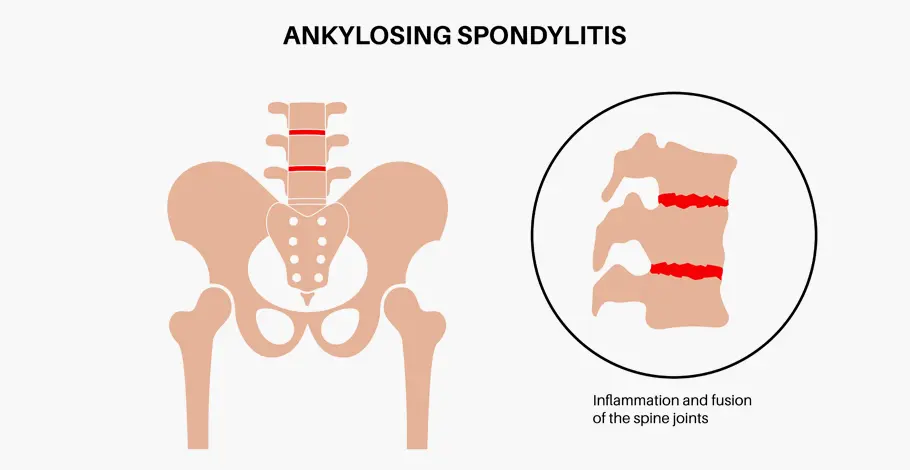
Ankylosing Spondylitis
Conclusion
AS is a long-term inflammatory condition, mostly hitting the spine and sacroiliac joints, and over time that adds up to pain, stiffness, mobility that’s genuinely not what it used to be. Nobody’s landed on one exact cause yet.
But catching symptoms early, getting diagnosed sooner, that part changes how manageable this becomes. Medication, physical therapy, regular exercise, decent daily habits- put those together and you’ve got a real shot at controlling inflammation and holding onto quality of life.
Ongoing back pain, morning stiffness, flexibility that keeps slipping- get it checked. Early treatment protects the spine, cuts complication risk, and makes everyday life better. With the right care, consistently applied, a lot of people with AS keep living active lives, independent ones, without this running the whole show.
Was this article helpful?
4 Sources
We review published medical research in respected scientific journals to arrive at our conclusions about a product or health topic. This ensures the highest standard of scientific accuracy.
[2] HLA-B27 Syndromes : https://www.ncbi.nlm.nih.gov/books/NBK551523/
[3] ASDAS, a highly discriminatory ASAS-endorsed disease activity score in patients with ankylosing spondylitis : https://ard.bmj.com/content/68/12/1811
[4] Erythrocyte Sedimentation Rate (ESR) : https://medlineplus.gov/lab-tests/erythrocyte-sedimentation-rate-esr/








 This article changed my life!
 This article was informative.
 I have a medical question.
 This article contains incorrect information.
 This article doesn’t have the information I’m looking for.