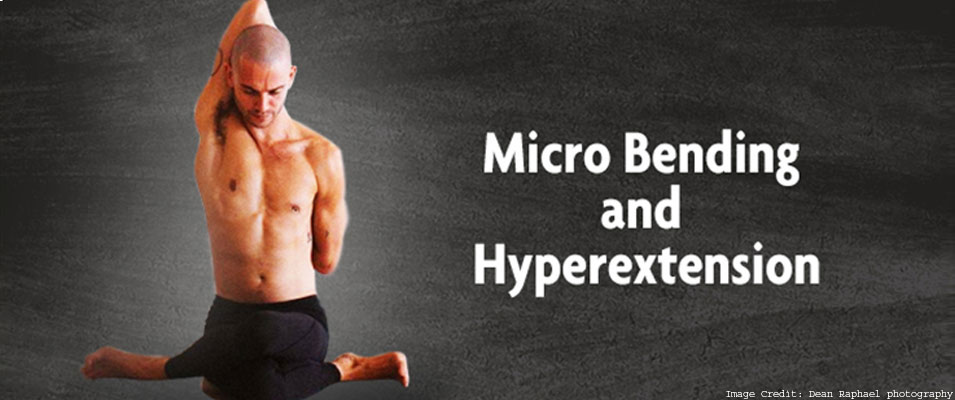
Hyperextension is the movement of extension or opening up past the healthy range of motion in any direction. At the mild end, it means moving just past the natural range of movement. At the extreme end, it can mean dislocation.
Micro bending is a cue or technique to avoid hyperextension and activate muscles around a joint complex. It means moving the joint back beyond being straight and into a subtle or not to subtle bend.
The debate is on how to avoid or counter hyperextension. And whether Micro bending is a viable solution, or just creates another problem.
Preventing Hyperextension with Micro bending
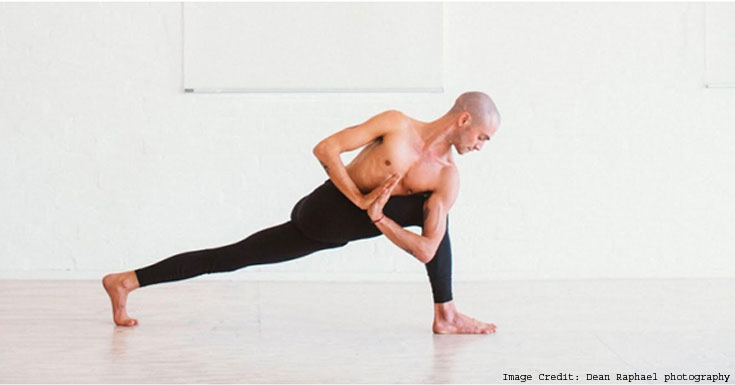
The cues is simple, to avoid your students hyperextending, instruct a micro bend. Meaning the Arm or leg changes from hyperextension and into the opposite, a slight bend in the joint. This means if the joint is loaded we need to add muscular activation to prevent the limb bending, and this works. A slightly bent knee will likely stabilize around the knee joint.
The problem with this solution is it isn’t the most efficient way to using the body as you are no longer bone stacking. All of a sudden not only is your body trying to hold what is often a challenging shape in space, but also using muscular effort to prevent a limb from bending rather than the primary idea in the shape.
Furthermore, the lines in the pose change, the lack of joint stacking will be felt all the way back to the spine often times causing counter adjustments from the body throwing your body even more out of alignment. This lack of intelligent alignment needs more activation often in the wrong places, it builds a challenging framework for the body to adapt too!
Possible Solution
The other solution is harder to achieve but comes without the drawbacks of micro-bending. This is to achieve joint stacking through activation all around the joint complex, achieving a seal or Bandha around the joint. For this the techniques or cues are much more complex. Either a double spiral, (internal and external rotation through each end of the limb), or another combination of action and counteraction, or combination of two movements.
Examples:
- Arms scrub in, shoulders press out
- Outer legs press down to the floor, perineum comes forward
- Palms rotate in, shoulders rotate out
- Feet rotate out, inner femur bones rotate in
See More: How Exercises Release your Anxiety? Check this Out!
By expressing in two directions we switch on muscles all around the joint complex and can enjoy stability and strength via activation, as well as reaping the benefits of joint stacking, making the pose lighter and easier for the whole body.
Feature Image Credit: Dean Raphael photography
Post In Image Credit: Dean Raphael photography